Antithesis Model Twenty-Two
Tinea and Leah: [Cyberpunk, Alien Incursions, Murder and Mayhem, Girl's Love (WLW)]Antithesis Model Twenty-Two is one of the largest and most strategically consequential Antithesis units encountered in the campaign. Its great size normally makes concealment difficult, yet its ability to dig into soft, storm-soaked ground and become a nest reverses that apparent weakness. The result is an enemy that can disappear beneath terrain, gather protective forces around itself, and convert a battlefield position into a new source of Antithesis growth.
Physical Scale and Concealment
Antithesis Model Twenty-Two is described as being roughly the size of a house, a scale that should make stealth nearly impossible under ordinary conditions. Leah notes that such bodies are usually heavily hindered by their bulk and difficult to hide. The landscape, however, is unusually favorable to concealment: persistent rain has turned the forest into soft mud, and a creature designed to dig into that terrain can be swallowed by ground that would otherwise expose it. The same weather that obscures heat signatures and erases digging traces therefore becomes an ally to the Twenty-Two.
The problem is not simply that a Twenty-Two can hide. Its hidden position disrupts attempts to reconstruct Antithesis movements. Leah and Tynea know the approximate location of an Antithesis nest, but the formations they have fought do not align with the expected distribution of enemy groups. That discrepancy leaves two possibilities: the Antithesis may have mutated into unfamiliar behavior, or additional spawning locations may exist where no obvious evidence can be found. The discovery that a Twenty-Two might be buried beneath one of the congregations supplies a third and more dangerous explanation: the visible groups may be screens for an underground source.
Nest-Building Function
Twenty-Twos are normally surrounded by very large numbers of other Antithesis units, often several hundred. Leah identifies two gatherings of approximately that scale and asks whether a hidden Twenty-Two may be beneath them. Tynea supports the deduction, turning what had seemed like unexplained population movement into a recognizable pattern of nest formation. The congregations are therefore not merely crowds of combat units; they can mark the defensive perimeter and logistical activity of a buried Model Twenty-Two.
The creature's strategic value becomes clearer when contrasted with other Antithesis models. In one later engagement, Leah finds Model Eights far from the caves. She considers the Eights useless in direct combat because they are large worms that consume biomass to feed a nest. Their presence is evidence of subterranean reproductive infrastructure rather than an attack force. The Twenty-Two belongs to the same broader logic of Antithesis expansion, but on a more consequential scale: once rooted, it can itself function as a nest, making the enemy position both a fortress and a production site.
Detection and Tactical Problem
Tynea's drones can detect a moving Twenty-Two only imperfectly, either by locating the unit itself or by finding a trail of destruction near enough to the search area. A stationary unit is much harder to identify. Rain can wash away heat signatures and traces of digging, while the storm can obscure damage to the forest that might otherwise reveal where a giant body has entered the ground. Tynea is also operating with only a limited number of drones and has kept them within a few kilometers in order to preserve coverage; drones sent close to Antithesis congregations are quickly spotted and destroyed.
This produces a tactical riddle in which absence of evidence is itself dangerous. A buried Twenty-Two need not move, expose its body, or announce its location through a clear trail. It can remain beneath a formation while the surrounding Antithesis units expand the apparent area of activity. Leah's suspicion is consequently based not on a direct sighting but on the relation between group size, unexplained arrivals from the forest, and the known habits of Twenty-Twos. The creature acts through the network around it before the humans can confirm its presence.
The Rooted Twenty-Two
Leah eventually receives confirmation that a Twenty-Two has rooted itself and probably turned into a nest. She had hoped to force it into movement and then ambush it with cannons, but rooting removes that opportunity. The fixed position is not passive, however. It is the center of an active hive, with surrounding units defending and maintaining the subterranean structure.
The tactical arrangement is complicated by Leah's chosen weapons. She has hidden the 150mm Towed Cannon on a small hill about two hundred meters away, using the elevation to target units around her. That position is useful against exposed enemies but poorly suited to an enemy underground. Leah considers whether the cannon can create a crater large enough to expose the nest, then asks Ypsilon how deeply the Twenty-Two is likely dug in. The estimate is only one or two meters, and the ruts left by its legs remain visible nearby. The creature is therefore not impossibly deep, but its shallow burial still places it beyond direct fire and turns the surrounding earth into armor.
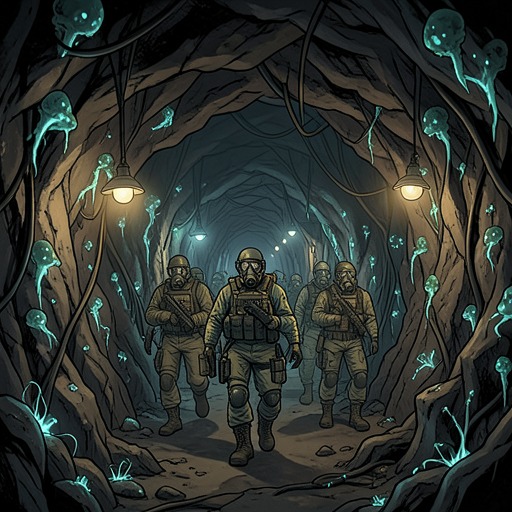
The visible defenders reveal what the rooted Twenty-Two is doing. Leah encounters Threes, Fours, Fives, and Sixes, along with many Ones that repeatedly dive-bomb her pod and are cut down by electrolasers. She also encounters fifty Tens, small, six-armed, legless, headless monkey-like units. The Tens are weak individually, but their presence indicates a proper hive: they care for feeding pools and inspect growth sacs. Their attack on Leah confirms that she is close enough to threaten the buried nest and that the Twenty-Two's biological infrastructure is already operating.
Destruction and Consequences
The campaign's destructive response reaches the buried reproductive system rather than stopping at its outer defenders. After a localized meteor storm, approximately fifty Threes remain, along with several Fours and two badly burned Eights. Leah orders Tynea to load nanite ammunition into the Eights, specifically so that no future nests will emerge from the position. This choice treats the nest's support organisms as a continuing threat: destroying visible combat units would not be enough if the reproductive machinery survived.
Antithesis Model Twenty-Two thus concentrates several recurring pressures in the book. It is enormous yet capable of concealment, biologically vulnerable yet tactically protected, and individually identifiable yet difficult to locate through conventional surveillance. Its presence reorganizes the meaning of enemy numbers around it: swarms, feeding pools, growth sacs, Eights, and Tens become signs of a buried reproductive center. The unit's importance lies less in a single attack than in its ability to make terrain, weather, drones, and surrounding Antithesis activity part of one defensive and reproductive system.